
Beowulf
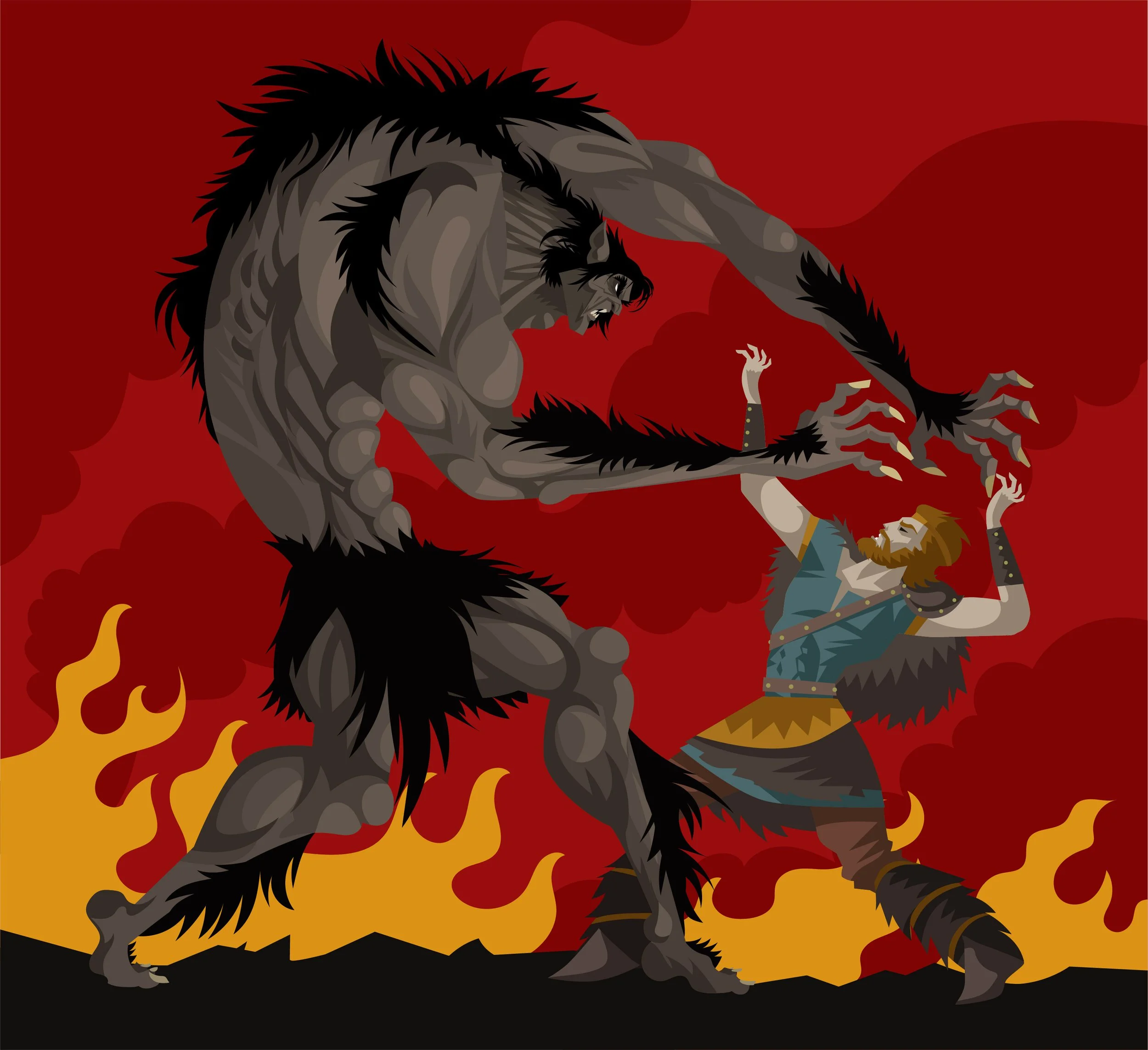
Beowulf is a poem that was written in Old English by an Anglo-Saxon scribe around 1000 CE, although the original poem is believed to date to the 8th to 11th centuries CE, and the story is set in Scandinavia.
Audio Narration
The retelling of Beowulf, narrated by Richard Galloway.
Part One
Beowulf and the Monster Grendel
Part Two
Beowulf and the Dragon
Background Context
The Story Behind the Story
Who is Beowulf?
Beowulf is a fictional character. In the Beowulf poem, he is a young warrior from the Geats who travels to Denmark to defeat the monster Grendel, purely for glory and the chance to help another king. He later becomes king of the Geats himself and rules for fifty years before (spoiler) dying in battle against a dragon. He is often considered the first hero in English literature, though he isn't English at all.
When was Beowulf written?
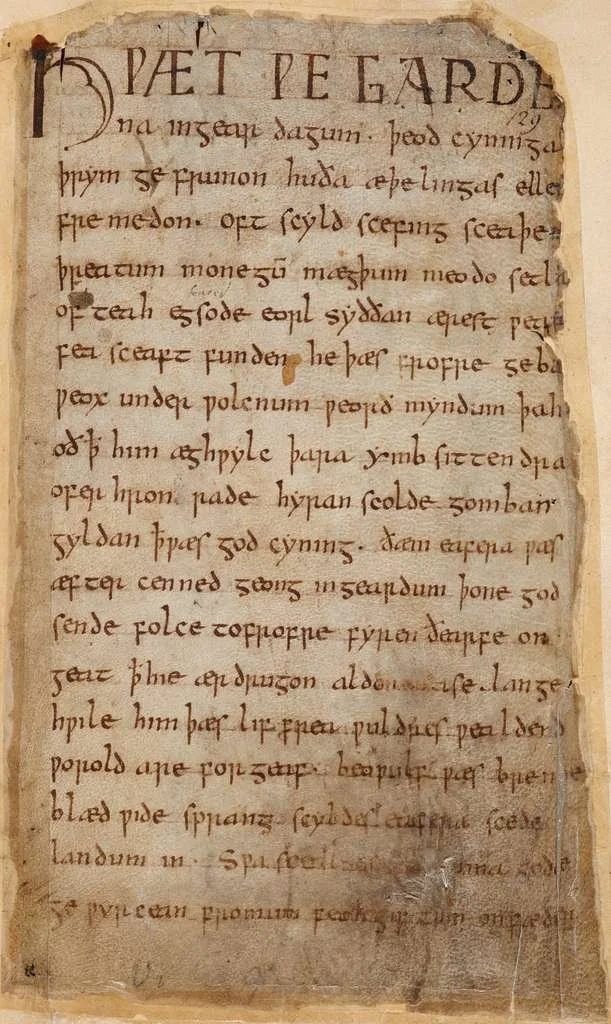
Scholars believe the poem was written somewhere between the 8th and 11th centuries AD, though nobody knows exactly when. The only surviving manuscript is kept in the British Library in London.
How was the story told?
During medieval times, stories were told by a poet and storyteller called a scop (pronounced "shop"). Scops performed poems like Beowulf aloud in mead-halls, often accompanied by a harp, and were responsible for keeping stories, histories, and genealogies alive in a largely oral culture. Beowulf itself was likely passed down by scops for generations before it was ever written down.
What is a kenning?
A kenning is a compact, poetic way of describing something without naming it directly, usually by joining two words together. Instead of "the sea," an Anglo-Saxon poet might say "the whale-road," because whales travel through it. Beowulf is full of kennings, and they are one of the most distinctive features of Old English poetry.
What happened to the original manuscript?
The single surviving copy of Beowulf came dangerously close to being lost forever. In 1731, a fire tore through the library where the manuscript was being stored, and although it survived, the edges of the pages were badly burned, and some text has been lost or is still disputed today. It is now kept safely in the British Library.
Is Beowulf based on a true story?
Probably not, at least not directly, though it isn't pure invention either. Grendel, his mother, and the dragon are fantasy, but some of the kings and tribes mentioned in the poem, including certain Geatish and Swedish rulers, were real historical figures and events from the 6th century. Beowulf himself has no confirmed historical counterpart.
Why is Beowulf still taught today?
Beowulf is one of the foundation stones of English literature, and its themes, heroism, mortality, loyalty, and the desire to be remembered, are still relatable more than a thousand years later. It also offers a rare, vivid window into Anglo-Saxon culture and values, written in the very language that would eventually grow into the English we speak today.
Additional Activity Ideas
The Words of Wiglaf: A Retelling of Beowulf
Part One
Beowulf and the Monster Grendel
WRITING
The Scop's Song
A scop was a travelling poet who sang stories aloud. Pupils write a short poem or simple ballad (four to eight lines) retelling the moment Beowulf arrives at Heorot. Encourage use of repeated phrases, strong rhythms, and alliteration. These should be performed aloud, not just read silently. Share with the class and let pupils vote on their favourite line.
Best for Grades 4-5 | Individual or pairs | 1 lesson
WRITING
The Monster's Diary
Grendel is cruel and terrifying but he is also lonely and cast out. Pupils write a short diary entry (8–10 sentences) from Grendel's point of view on the night before he attacks Heorot. What can he hear? How does it make him feel? Does he want to be feared, or does he want something else? Encourage empathy. Grendel can feel things too, even if he acts terribly.
Best for Grades 4-5 | Individual | Homework or 1 lesson
WRITING
A Letter Home
One of Beowulf's fourteen companions writes a letter to his family the night before they land in Denmark. What does he say? Is he scared? Does he tell the truth about how dangerous the mission is, or does he pretend to be braver than he feels? Pupils must use details from the text (the sea crossing, the stories of Grendel, Beowulf's plan to fight bare-handed). Provide a letter template for P4.
Best for Grades 3-4 | Individual | 1 lesson or homework
DRAMA
Freeze Frame: The Night Grendel Came
Pupils work in groups of five. Each group creates three freeze frames: (1) the hall full of feasting warriors, (2) the moment Grendel enters, (3) the aftermath at dawn. Pupils must use body language and facial expression to tell the story without speaking. After each freeze frame, the teacher taps one pupil who speaks their character's thoughts aloud in role.
Best for Grades 3-5 | Groups of 5 | 30–40 minutes
Part Two
Beowulf and the Dragon
SEL
The Debate: Should Beowulf Have Gone?
Beowulf is an old man when he faces the dragon. He is also a king with a people who depend on him. Run a structured debate: should he have faced the dragon himself, or sent younger warriors? One side argues it was his duty and his right. The other argues a king's first duty is to his people, and an old king risking death for glory is reckless. Pupils find evidence from the text for both sides.
Best for Grade 7 | Whole class | 1 lesson
DRAMA
Twelve Riders
The text tells us twelve riders circled the barrow chanting Beowulf's name and his deeds. In groups of four to six, pupils create a short choral piece, part movement, part spoken word, to perform as the funeral procession. Each pupil is responsible for one deed or quality, chosen from the text. The piece must begin with silence and end with silence. No music, no props: just voice and stillness.
Best for Grades 4-6 | Groups of 4–6 | 1–2 lessons
SEL
What Do We Owe Each Other?
Wiglaf stays. Ten warriors run. Both choices are human. Discuss with pupils: Is it fair to judge the ten? What does loyalty actually mean, and does it have limits? Is there a difference between being afraid and being a coward? Use Wiglaf's line "anger felt too small" as a starting point: what emotions are bigger than anger? Connect to real situations like standing up for someone, telling the truth when it's hard, staying when it would be easier to go.
Best for Grades 4-6 | RME / PSHE | Discussion lesson
WRITING
Kenning for a Dragon
The Old English poets used kennings (two-word compound descriptions) to name things without naming them directly (whale-road = sea; bone-house = body). Pupils invent kennings for the dragon in Part 3, drawing on specific details from the text: the fire, the scales, the barrow, the poison. They must write at least five kennings and then choose their best one to illustrate. Share and compile a class "dragon glossary." Challenge extension: write two kennings for Wiglaf.
Best for Grades 3-5 | Individual | 45 minutes
Old English Pronounciation Guide
Beowulf - BAY-oh-wolf
Wiglaf - WEO-laf
Weohstan -WAY-oh-stan
Hrothgar -HROTH-gar
(the HR is a slight breath before the R, like clearing your throat gently)
Grendel - GREN-del
Unferth - UN-ferth
Hygelac - HUG-eh-lak
Peoples and Places
Geats - GEE-ats
Danes - DAYNZ
Heorot - HAY-oh-rot
Swords and Weapons
Hrunting - HRUN-ting
(Unferth's sword, lent to Beowulf for the fight with Grendel's mother)
Naegling - NAY-gling
(Beowulf's own sword, which shatters during the dragon fight)
Shop
Each Part of the Word of Wiglaf bundle includes illustrated reading pages, comprehension questions, interpretation questions, activities and an answer key. Available as a PDF download, either in individual parts, or as a bundle with all both parts.

Bring the complete story of Beowulf into your classroom with this illustrated, two-part bundle, carefully adapted for upper elementary and middle school students. Part One follows the young warrior Beowulf as he crosses the sea to free King Hrothgar's kingdom from the monster Grendel and his vengeful mother. Part Two picks up decades later, as an aging King Beowulf faces his final battle, a fight against a dragon, in a fitting and moving conclusion to his story. Together, the two parts trace Beowulf's full arc from bold young hero to wise old king who gives everything to protect his people to the end. Each part includes comprehension questions in true/false, multiple-choice, and written-response formats, along with a supporting vocabulary list, making this bundle ready for close reading, classroom discussion, or independent study. Purchasing the bundle offers better value than buying each part separately, and part files are kept separate for easy updating and flexible use.

Grades 4–8 | Ages 9–13
Pages: 15
Bring the oldest story in the English language to life with this illustrated, classroom-ready retelling of Beowulf. Part One (Beowulf and the Monster Grendel) covers the monster Grendel, the great hall of Heorot, and Beowulf's legendary descent into the mere, told with the atmosphere and language of the original epic, carefully adapted for upper elementary and middle school students. This resource can be used on its own or alongside Part Two (Beowulf and the Dragon) to explore the complete story of Beowulf.
What's Included
An illustrated 4-page retelling of Beowulf
Vocabulary page (with cheat sheet of names)
Comprehension questions (true or false, multiple choice)
Explore and interpret questions (could be done individually or as a class discussion)
Kennings explanation and activities
Illuminated Letter activity (differentiated)
Wanted poster activity
Storyboard activity
Matching activity (match the original translation to the modern English)
Answer sheets (including model answers for Explore & Interpret)

Grades 4–8 | Ages 9–13
Pages: 16
The story continues with this illustrated, classroom-ready retelling of Beowulf. Part Two tells the story of Beowulf's final battle, his fight with the dragon, carefully adapted for upper elementary and middle school students. Decades after defeating Grendel and his mother, an aging Beowulf must face one last threat to protect his people, a fitting and moving conclusion to his story. This resource includes a vocabulary list to support close reading. It can be used on its own or alongside Part One to explore the complete story of Beowulf from beginning to end.
What's Included
An illustrated 4-page retelling of Part Two of Beowulf
Vocabulary page (with cheat sheet of names)
Comprehension questions (true or false, multiple choice)
Explore and interpret questions (could be done individually or as a class discussion)
Sutton Hoo explanation and activity
Classroom Discussion
Character Portrait art activity
The Slave's Story writing activity
The Dragon's Hoard Inventory activity
A Warrior's Letter writing activity
Make a Comic art activity
Answer sheets (including model answers for Explore & Interpret)